AEO tool for tracking AI answer visibility
An AEO tool measures whether AI answer engines name your brand, how they describe you, and who they recommend instead. AEO tracking software turns that answer visibility into a repeatable metric instead of a one-time ChatGPT check.
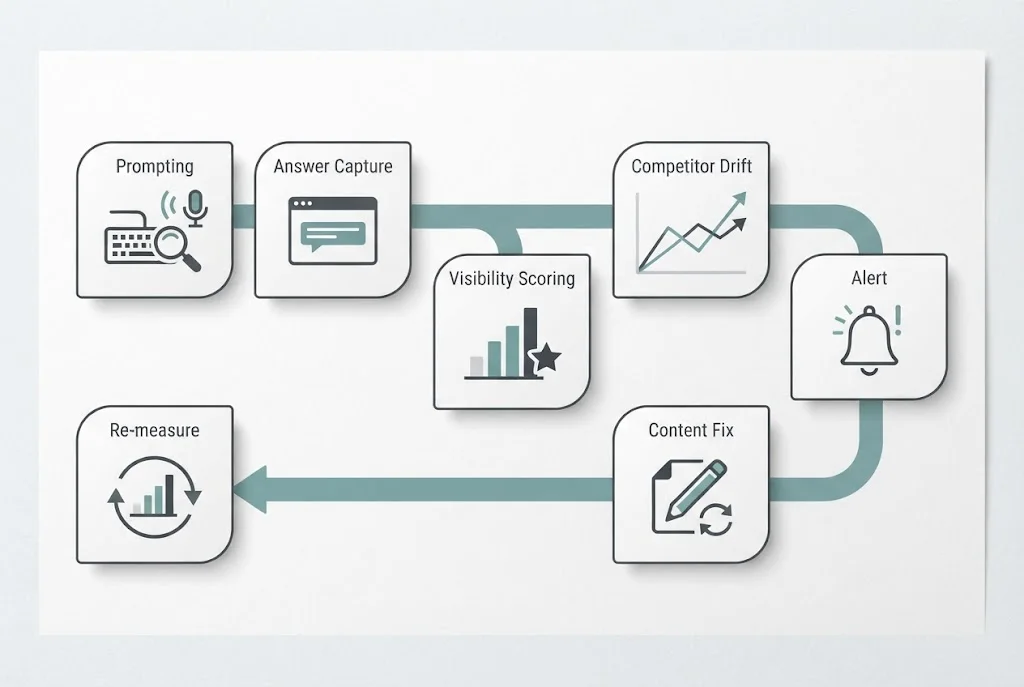
What an AEO tool does
An AEO tool monitors your brand inside AI-generated answers. For each buyer prompt, it captures the answer, checks whether your brand appears, scores the placement and framing, and compares your presence against the competitors named instead.
The goal is not to replace SEO. SEO still helps answer engines find and trust your pages. AEO software measures the surface your SEO tools usually miss: the synthesized answer buyers read before they click. An AEO platform adds team reporting and workflow around that measurement.
Why manual AI checks fail
A manual check answers one narrow question: what did the model say just now? That can be useful for a first look, but it breaks as a reporting system. Answers change by engine, prompt wording, retrieval source, freshness, and sample. One answer can look good while the broader prompt set is already moving against you.
Tracking works differently. It runs the same prompts on a cadence, stores the answer, scores it consistently, and shows the trend. That is the difference between a screenshot and a channel metric.
What to measure
A strong AEO tracker should explain why visibility moved, not just show a score. These are the core metrics:
Presence
Whether the answer names your brand at all for the prompt. This is the floor for every AEO measurement.
Position
Where your brand appears inside the answer: first recommendation, middle of a list, alternative, or footnote.
Sentiment
How the answer frames your brand. A mention with caveats is not the same as a confident recommendation.
Competitors
The brands the answer engine names instead of you. This is often the real competitive set buyers see.
Share of voice
How often you are named versus competitors across the prompt set, tracked over time instead of as screenshots.
Movement
Whether a citation, position, sentiment, or competitor changed since the last run.
Manual checks, free checker, AEO tracker, or platform?
These options are not interchangeable. Pick the level that matches the decision and reporting cadence you need now.
Evaluation checklist
Before choosing a tracker, look for the capabilities that make the data useful enough to act on:
- Tracks full answers, not only cited domains.
- Covers multiple engines on one timeline.
- Stores raw answers so the team can audit the score.
- Measures competitors the AI actually names.
- Runs on a cadence and alerts on movement.
- Connects gaps to specific page or content fixes.
- Needs no tag, SDK, or access to analytics.
Research notes behind the workflow
The workflow has to separate three layers that are easy to blend together: content eligibility, crawler access, and answer presence. Google says AI Overviews and AI Mode use Search systems and supporting links from the Search index. OpenAI documents separate controls for OAI-SearchBot and GPTBot, so a site can allow search discovery while disallowing training use. Perplexity documents both PerplexityBot and Perplexity-User, with WAF guidance because security tooling can block legitimate answer-engine fetches.
Prompt selection matters just as much as crawler access. Sonarvue's 29,775-prompt B2B SaaS study documents a reproducible starting set for shortlist, alternatives, and problem-led monitoring.
Where Sonarvue fits
Sonarvue tracks ChatGPT, Claude, Gemini, Perplexity, and Google AI Mode on one timeline. It captures the real answer for each prompt, scores whether your brand is named, calculates share of voice, and alerts you when a citation or rival moves.
It is built for founder-led and growth-stage B2B teams that already treat organic as a channel and now need to measure the answer surface. No tag, no SDK, and no site change. The first read completes in minutes.
Related resources
Start with the AI visibility pillar, follow the AI visibility optimization checklist, use the AI visibility report template, understand the AI visibility score, compare the best AI visibility tools, read AEO vs SEO, or run a free AI visibility check.
Frequently asked
What is an AEO tool?
An AEO tool monitors whether answer engines name and cite your brand for buyer prompts. AEO tracking software adds repeat runs, history, presence, position, sentiment, competitors, share of voice, and movement over time so teams can measure answer-engine optimization instead of relying on manual checks.
How is AEO tracking different from SEO rank tracking?
SEO rank tracking measures where a page appears in search results. AEO tracking measures the synthesized answer: whether your brand is included, how it is described, and who gets recommended instead.
Can I track AEO manually?
You can spot-check prompts manually, but it does not scale. Answers change by prompt wording, model, sample, and time. A monitor runs the same prompt set on a cadence and turns answer movement into a trend.
Which engines should AEO tracking software monitor?
A useful AEO tracker should cover the answer engines your buyers use. Sonarvue monitors ChatGPT, Claude, Gemini, Perplexity, Google AI Overviews, Microsoft Copilot, Grok, and Kimi on one timeline.