AI visibility score
An AI visibility score summarizes whether answer engines name your brand, where you appear, how they describe you, and who they recommend instead. The score is useful only when the prompt set, engines, and competitors are explicit.
Definition
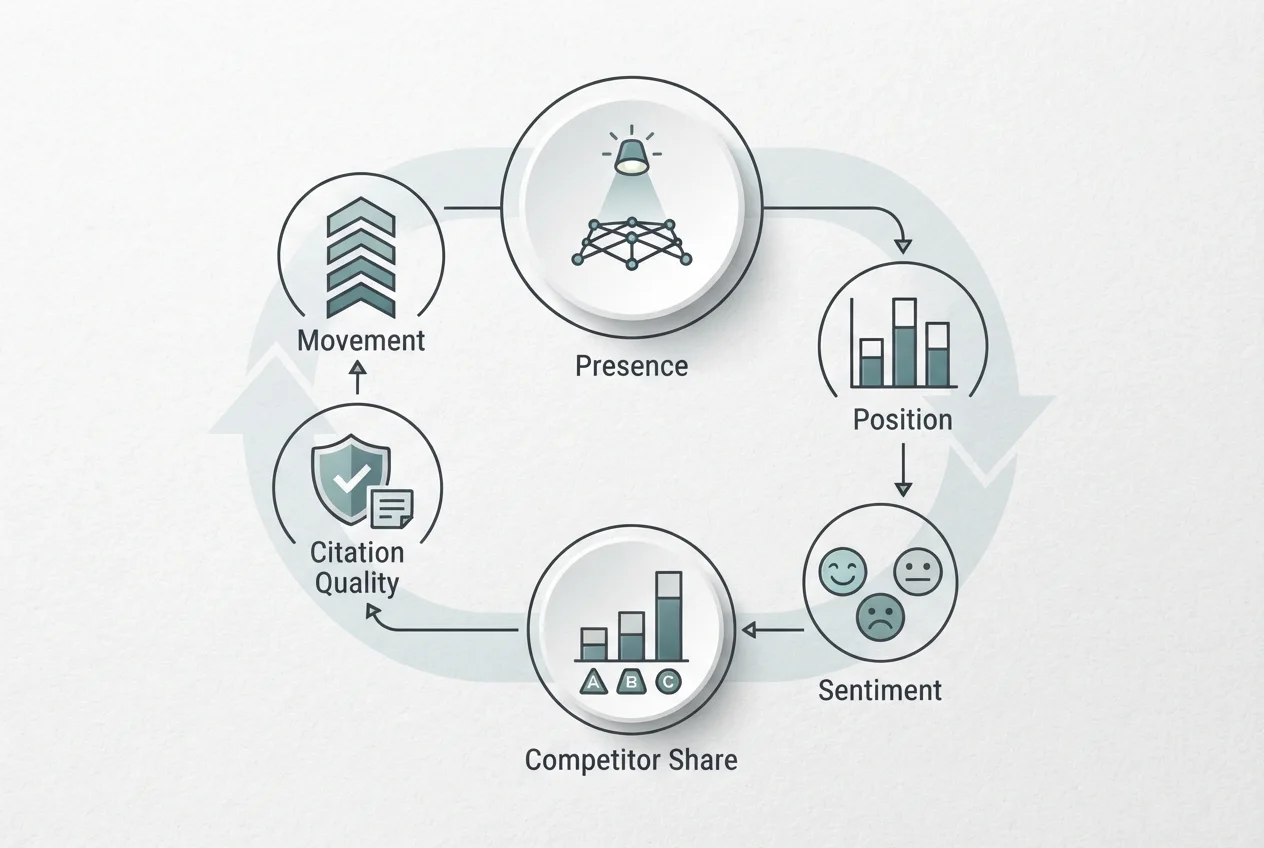
An AI visibility score is a 0-100 summary of your brand's presence inside AI-generated answers. It measures the answer itself: whether your brand is named, where it appears, how accurately it is described, what sources support the answer, and which competitors are recommended instead.
This is not the same as SEO visibility. SEO visibility measures how a page performs in search results. AI visibility score measures whether the brand appears inside the synthesized recommendation a buyer reads before clicking.
Research basis
This framework is based on how the major answer surfaces describe retrieval, crawler access, and answer support. Google says its generative Search features still rely on core Search ranking and quality systems, including retrieval-augmented generation and query fan-out. OpenAI separates search visibility from training access with different crawlers, while Perplexity publishes separate user agents for search crawling and user-requested fetches.
Formula
Sonarvue treats the score as a weighted prompt-level average, then rolls the prompt scores into a brand-level trend:
AI visibility score =
average across prompts and engines of:
presence + prominence + sentiment + citation support + competitive context
The formula is deliberately explainable. A score should tell a team what moved and why. If a tool cannot show the raw answer, the prompt, the engine, and the competitors named beside you, the score is too opaque to guide content work.
What goes into the score
Prompt set matters more than the number
A visibility score is only as good as the prompts behind it. A useful prompt set should include buyer questions, not vanity questions. Start with category shortlists, alternatives, comparisons, problem definitions, and "best tool for" queries that a real buyer would ask before visiting a vendor site.
Do not compare two scores unless the prompt set, engines, geography, cadence, and competitor list are similar. A score across five easy prompts is not better than a lower score across twenty revenue-critical prompts. Context is the measurement.
How this differs from other public definitions
Public definitions are converging, but they are not identical. Semrush describes AI visibility as a 0-100 benchmark based on appearance in AI-generated answers compared with competitors. Profound frames visibility score as mention rate across tracked responses. Ahrefs checks how often major AI platforms mention and cite a brand. Sonarvue's version keeps those ideas but adds answer position, sentiment, source support, and explicit competitor context.
Visibility score vs share of voice
What a good score looks like
There is no universal "good" AI visibility score yet. Categories, prompts, answer engines, and competitors differ too much. A useful benchmark is local: compare your score against named competitors for the exact prompts your buyers ask, then watch whether the score moves after content, PR, review, or source changes.
A score that rises without better answer evidence is suspect. The score should be explainable in plain terms: you were named on more prompts, you moved higher inside the answer, a source started citing you, sentiment improved, or a competitor lost share.
How to improve the score
- Fix missing entity clarity. Make your category, audience, and use case obvious on your homepage and pillar pages.
- Close source gaps. Publish comparison, pricing, FAQ, and methodology pages that answer engines can cite.
- Earn third-party mentions. Directories, reviews, partner pages, podcasts, and industry roundups often influence AI answers.
- Track competitors by prompt. Do not optimize against guessed rivals. Optimize against the brands the answer actually names.
- Re-measure on a cadence. One screenshot is not a metric. Weekly or daily tracking turns noise into trend.
Where to go next
Start with the AI visibility pillar, run a free AI visibility check, compare free AI visibility checkers, or evaluate AEO tracking software. If ChatGPT is the first engine you care about, use the guide on tracking brand mentions in ChatGPT.
Frequently asked
What is an AI visibility score?
An AI visibility score is a 0-100 summary of how visible a brand is inside AI-generated answers for a tracked set of buyer prompts. It combines whether the brand is named, where it appears, how it is described, and how it performs against competitors.
What is a good AI visibility score?
There is no universal benchmark yet. A good score is relative to your category, competitors, prompt set, and engines. The useful signal is whether your score and share of voice improve over time on the prompts that matter.
Is AI visibility score the same as share of voice?
No. AI visibility score summarizes your absolute presence and quality across prompts. AI share of voice compares your presence against the competitors named in the same answers.
How often should you measure AI visibility?
Weekly is a practical minimum for early teams. Daily tracking is useful once AI visibility becomes a reporting metric or when competitors are moving quickly.