ChatGPT brand visibility: how to track mentions
ChatGPT brand visibility shows whether AI answers name your brand, how they describe you, and who they recommend instead. Here is how to measure it.
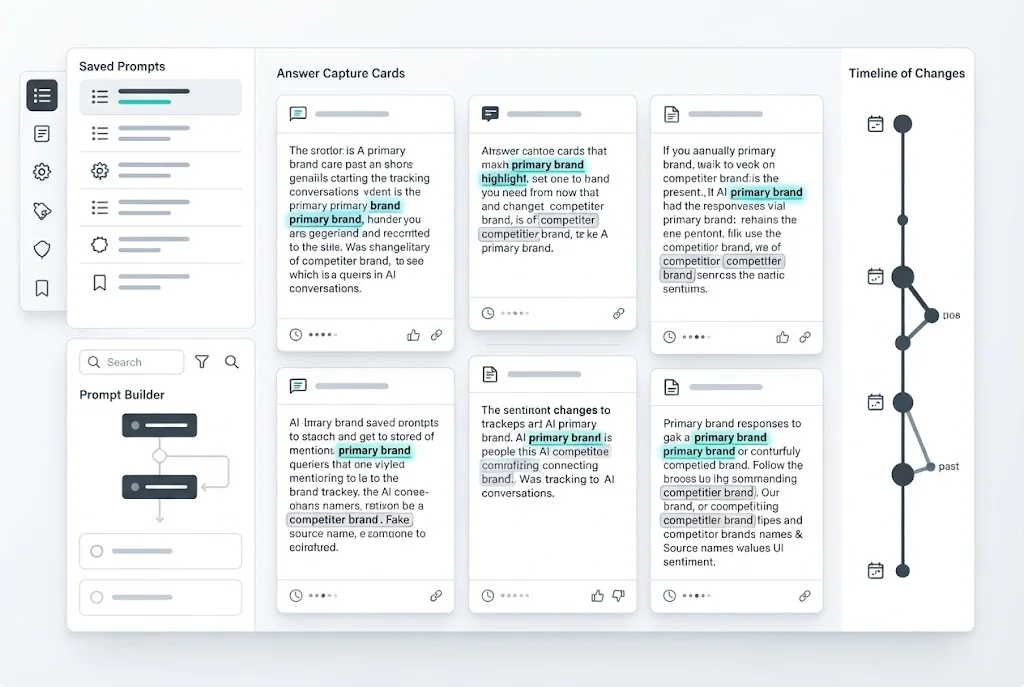
ChatGPT brand visibility is whether ChatGPT names your brand when buyers ask about your category, how it describes you, and which competitors it recommends instead. It is one part of the broader AI visibility problem: the buyer may form a shortlist before they ever visit Google, your homepage, or a review site.
Typing your brand into ChatGPT once is not measurement. It is a spot-check. To track brand visibility properly, you need a repeatable prompt set, consistent scoring, competitor context, and a cadence that shows whether visibility is moving.
What ChatGPT brand visibility includes
ChatGPT brand visibility is more than “were we mentioned?” A useful read captures the full answer context:
- Presence. Did ChatGPT name your brand at all?
- Position. Were you first, buried in a list, or framed as an alternative?
- Description. Did the answer explain your product accurately?
- Sentiment. Was the mention favorable, neutral, outdated, or caveated?
- Competitor set. Which brands did ChatGPT recommend instead?
- Source pattern. Which pages, reviews, docs, or public discussions appear to support the answer?
- Movement. Did the answer change since the last run?
That last point matters. The goal is not to win one answer once. The goal is to know whether your brand is becoming more or less visible for the prompts that can influence pipeline.
Why one ChatGPT spot-check fails
A single manual check breaks in four ways.
- Answers are non-deterministic. Ask ChatGPT the same question twice and you can get two different shortlists. One reading tells you nothing about what the engine usually says.
- There is no history. You saw today’s answer. You have no record of last week’s, so you cannot tell whether you are gaining ground or quietly losing it.
- It is one sample. The wording, freshness, model, and retrieval path can change what ChatGPT says.
- There are no competitors in frame. “Were we mentioned?” is not enough. The question that matters is “who got named instead of us, and how often?”
Put together, the spot-check gives you a feeling, not a number. Feelings do not go in a board deck.
The prompts to track
Do not start with your brand name. Start with the questions a buyer asks before they know who to shortlist:
- “best [category] tools”
- “best [category] software for [persona]”
- “[competitor] alternatives”
- “[category] tools for [use case]”
- “how to solve [problem]”
- “what is the best way to [job to be done]”
For Sonarvue, examples would include “best AI visibility tools,” “AEO tracking software,” “how to track brand mentions in ChatGPT,” and “AI brand monitoring tools.” Those are the prompts where a buyer can discover the category and form a shortlist.
How to track brand mentions in ChatGPT
Use a consistent loop so each run can be compared to the last one.
1. Pick the prompts your buyers actually ask. Not your product name. The questions a buyer types before they have heard of you: “best X for Y,” “X alternatives,” “how do I solve Z.” Start with ten. These are the prompts where the decision gets made.
2. Run each prompt on a schedule. Weekly is enough for a new baseline. Daily is better if your category changes quickly or competitors publish often.
3. Save the raw answer. Do not only save a yes/no result. Keep the answer text so you can see how the description, framing, and competitor list changed.
4. Score every answer the same way. Mark presence, position, sentiment, competitor mentions, and inaccurate claims. Consistency is the whole point.
5. Calculate share of voice. Count how often ChatGPT names you versus the competitors in your prompt set. We go deeper on this in share of voice in AI answers.
6. Compare ChatGPT to the other engines. ChatGPT is important, but it is not the whole answer-space. A serious monitor also tracks Claude, Gemini, Perplexity, and Google AI Mode.
Manual tracking vs monitoring
| Manual ChatGPT checks | AI visibility monitoring |
|---|---|
| One prompt at a time | Saved prompt set across the buyer journey |
| One answer sample | Repeated runs on a cadence |
| Hard to compare over time | Trend line for presence, position, sentiment, and share of voice |
| Usually ignores competitors | Tracks who ChatGPT recommends instead |
| Easy to forget | Alerts when visibility or competitors move |
Manual checks are fine for a first look. They stop working when you need to report a channel, defend a content plan, or catch a competitor gaining ground before the quarter is over.
What to do when ChatGPT does not mention your brand
Missing from the answer usually points to one of four gaps.
The category is unclear. Your site does not plainly say what you are, who you are for, and which problem you solve.
The proof is thin. ChatGPT has little to cite: no clear docs, comparisons, examples, public mentions, or third-party validation.
Competitors own the query shape. The pages and discussions ChatGPT can retrieve are written around your competitors’ language, not yours.
The answer is outdated. The engine may have an old understanding of your product, pricing, positioning, or feature set.
The fix is not to stuff “ChatGPT brand visibility” into a page 20 times. The fix is to make your category evidence clearer: a direct category page, comparison pages, FAQs, pricing, product docs, public proof, and third-party mentions that all describe the brand consistently.
How Sonarvue automates this
Sonarvue runs your buyer prompts across ChatGPT, Claude, Gemini, Perplexity, Google AI Overviews, Microsoft Copilot, Grok, and Kimi. It captures the real answers, scores whether your brand is named, tracks share of voice against competitors, and alerts you when a citation or rival moves.
You can start with a manual spreadsheet, or you can run a free AI visibility check and get the first read in minutes. No tag, no SDK, no site change.
Frequently asked questions
How do I know if ChatGPT mentions my brand?
Ask ChatGPT the category and comparison prompts your buyers use, not only your brand name. Save the raw answer, note whether your brand appears, record competitors, and repeat the same prompts on a schedule.
Is ChatGPT brand visibility the same as SEO?
No. SEO measures whether a page ranks in search results. ChatGPT brand visibility measures whether the answer names your brand, how it frames you, and which competitors it recommends instead.
How often should I check ChatGPT visibility?
Weekly is a practical starting point. Daily checks make sense for competitive categories, active launches, or teams using AI visibility as a reporting metric.
Should I only track ChatGPT?
No. ChatGPT is a major engine, but buyers also use Gemini, Perplexity, Claude, Copilot, and Google AI Mode. Track ChatGPT first if you need a starting point, then expand to the engines your buyers use.