Best AI visibility tools (2026)
The best AI visibility tools show whether answer engines name your brand, how you compare with competitors, and what changed. This guide evaluates the best AEO tools and best GEO tools by measurement depth, operating fit, and the decisions their data can support.
We make one of the tools in this category, so read this as an interested party. We have kept the bulk of the page about how to choose - not about us - and we name other players only at a level we can stand behind. Where Sonarvue genuinely fits, we say so plainly at the end.
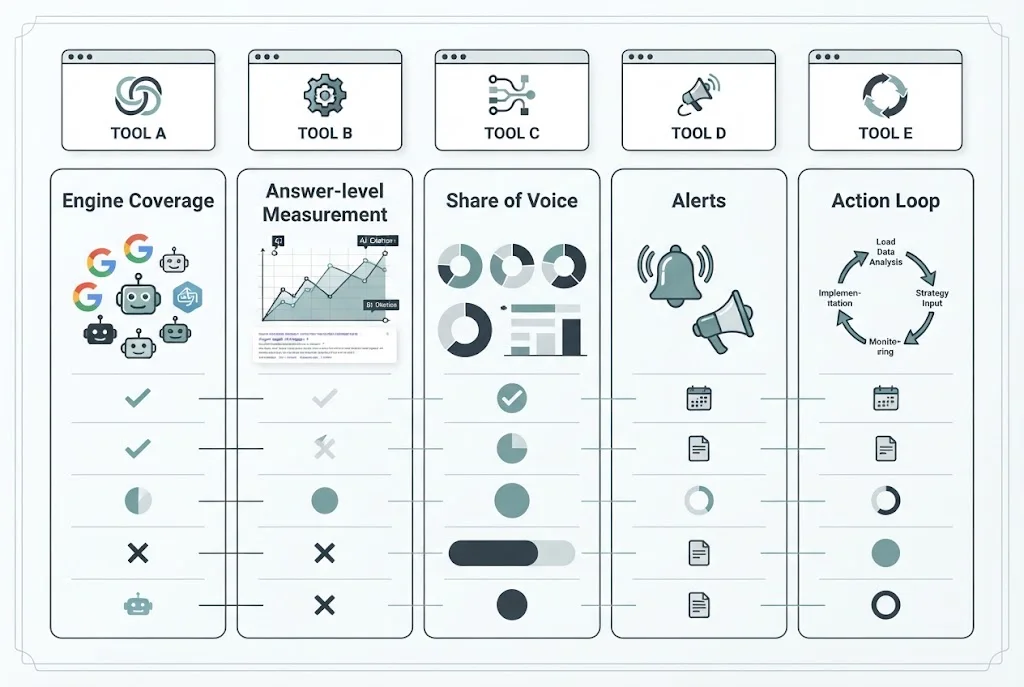
What an AI visibility tool actually does
An AI visibility tool measures how AI answer engines - ChatGPT, Claude, Gemini, Perplexity, and Google AI Mode - describe and cite your brand when someone asks a buying question. This is the AEO / GEO category: answer-engine optimization and generative-engine optimization. Instead of tracking blue links, it tracks the answer itself - whether you are named, where you sit in the response, how the model talks about you, and which competitors it recommends in your place.
The category is young, and tool quality varies more than the marketing pages suggest. The eight criteria below are the ones that decide whether a tool tells you something you can act on, or just gives you a number that moves for reasons you cannot explain.
Best AI visibility tools by team
Start with operating fit, not feature count. The best tool for a founder checking one brand is different from the platform an agency or enterprise needs to govern many prompt sets.
Research basis for the criteria
The criteria below start from how the answer systems work, not from a vendor feature checklist. Google says its generative Search features rely on Search ranking and quality systems, query fan-out, and supporting links. OpenAI and Perplexity publish separate crawler and user-agent behavior, which means access, citation, and answer presence need to be measured separately. A good AI visibility tool should show those layers clearly enough that a team can act on the evidence.
How to choose an AI visibility tool: eight criteria
01 Cover every engine your buyers actually ask.
Engine coverage
Your customers do not split evenly across one model. A tool that watches only ChatGPT misses the answer a buyer got from Gemini or Perplexity. Look for coverage of ChatGPT, Claude, Gemini, Perplexity, Google AI Overviews, Microsoft Copilot, Grok, and Kimi - and check that each is the real answer surface, not a generic API completion.
02 Measure the answer, not just whether a link appeared.
Answer-level vs link-level
Some tools only check whether your domain shows up as a cited link. That misses the part that decides the sale: whether the model names you, in what position, with what sentiment, and which rivals it lists instead. Prefer a tool that reads the full answer and judges your place inside it.
03 See your share of the answer against the brands named beside you.
Share of voice
Being mentioned is not the same as winning the answer. The number that matters is how often you are named versus the competitors the model surfaces in your place. A share-of-voice score turns scattered mentions into a position you can defend or attack.
04 Track the rivals the AI names, not a list you guessed.
Competitor tracking
The useful competitor set is the one the model actually recommends for your prompts - which is often not the list on your battlecard. A strong tool surfaces who the AI names instead of you, so you learn the real competitive field from the answers themselves.
05 Get told when a citation or a rival moves.
Alerting
AI answers drift. A model that recommended you in March can drop you in June after a single index refresh. Without alerts you find out a quarter late. Look for change detection on citations, position, sentiment, and competitor movement - pushed to you, not buried in a dashboard.
06 Watch the public chatter the models are trained and grounded on.
Social listening
Answer engines lean on public discussion. Coverage of LinkedIn, Reddit, and X tells you where a narrative is forming before it hardens into the answer. It is a leading indicator for the citations that follow, and a useful tie-break between otherwise similar tools.
07 Choose a tool that reads public answers with no tag to install.
Time-to-value and no-install
AI visibility lives in answers the models give the public, so a tool should not need a tag, an SDK, or access to your analytics. The honest test is the first read: you should see how the engines describe you within minutes of adding a brand, not after an engineering ticket.
08 Trust a cadence and sampling, not one lucky answer.
Methodology and trend
A single answer is noise. Real measurement runs each prompt repeatedly on a cadence - weekly, daily, or on demand - across multiple samples, then rolls the results into a stable trend. Ask any tool how it samples and how often; if it can only show you one snapshot, it cannot show you a direction.
The players in the AI visibility category
Sonarvue is one option. There are others: Profound, Otterly.ai, and Peec AI are also answer-engine visibility trackers in this space (each links to an honest comparison), and Rankscale, AthenaHQ, and Scrunch round out the field. New entrants appear often as the category grows. We are deliberately not publishing a feature-by-feature table or quoting competitor pricing here - those details change quickly, and a guide that gets them wrong is worse than one that sends you to the source. Take each vendor through the eight criteria above against their own current docs and a trial. That comparison will hold up better than any grid we could freeze in place.
Free checker or paid monitor?
A free AI visibility checker is useful for the first question: "Do the engines name us right now, and can they read our site?" A paid monitor is useful for the operating question: "Is our share of voice changing, which competitor moved, and what should we fix this week?" Treat free checks as a baseline, not as your reporting system.
For the free-tool layer, compare the current free AI visibility checkers. For ongoing monitoring, use the eight criteria above and favor answer storage, prompt cadence, competitor movement, and clear methodology. Sonarvue's public AI visibility score page shows the scoring inputs we expect any serious tool to explain. If you need the operating workflow, use the AI visibility optimization checklist. If you are still reporting manually, use the AI visibility report template. If HubSpot is your starting point, compare the HubSpot AEO Grader alternative. If Ahrefs is your starting point, compare the Ahrefs AI Visibility Checker alternative. If Semrush is your benchmark, compare the Semrush AI Visibility Toolkit alternative.
Best AEO tracking software: what to look for
The best AEO tracking software does not just ask whether your domain was cited. It tracks the answer buyers see: whether the engine names your brand, where you appear, how the answer describes you, and which competitors get recommended instead. That makes the output useful for both SEO teams and founders who need to know if the AI shortlisted them.
AEO tracking also needs cadence. A one-time screenshot cannot show whether a competitor is gaining share of voice or whether a GEO change worked. If you want the full buying checklist, use the dedicated AEO tracking software guide. If you want the page-by-page optimization workflow, follow the AI visibility optimization checklist. If you want a quick baseline first, run the free AI visibility check.
Where Sonarvue fits - and where it does not
Sonarvue is the AI answer-engine visibility monitor we build. For each prompt it captures the real answer, then judges whether your brand is named, in what position, with what sentiment, and against which competitors - and rolls that up into a visibility score and a share-of-voice number. It runs on a cadence (weekly, daily, or on demand) across multiple samples, so it reports a stable trend rather than one lucky answer, and it alerts you when a citation or a rival moves. It covers all eight default engines, adds social mentions from LinkedIn, Reddit, and X, and needs no tag and no SDK - your first read completes in minutes by reading public AI answers. Monitoring needs no access to your analytics or customer data.
It is a good fit if you are a founder-led or growth-stage B2B SaaS or digital-first brand selling a considered, research-heavy purchase, and you already treat SEO and organic as a real channel. It is built for solo founders and marketers, Heads of Growth and Demand Gen, and SEO and content leads - with an agency tier for teams running many brands.
It is not the right tool if you need on-page analytics, session recording, or anything that depends on instrumenting your own site - Sonarvue measures the public answer surface, not your traffic. And if your buyers do not research with AI yet, the signal will be thin; this is for categories where the answer engine is already in the buying path.
Pricing
Sonarvue is in beta. The trial gives one brand a scan and report, so you can see how the engines describe you before committing to a monitor. Starter is $20/mo for 25 tracked prompts, one brand, and three members. Team is $75/mo for 100 prompts, up to three brands, six members, Google Search Console integration. The honest starting move is the trial report.
Frequently asked
What is the best AI visibility tool?
The best AI visibility tool depends on the job. For a first read, use a checker that tests site readiness and answer mentions. For ongoing measurement, use software that tracks saved buyer prompts, multiple engines, answer-level presence, competitors, share of voice, and movement over time.
What is the best AEO tracking software for small B2B teams?
Small B2B teams should look for AEO tracking software with no-install setup, transparent pricing, multi-engine coverage, prompt history, share of voice, competitor tracking, and clear next actions. The important test is whether the tool shows what the AI answer says, not only whether a domain was cited.
Are AI visibility tools different from SEO tools?
Yes. SEO tools measure rankings, keywords, backlinks, and pages. AI visibility tools measure the answer surface: whether ChatGPT, Claude, Gemini, Perplexity, or Google AI Mode names the brand, how it frames the brand, and which competitors appear instead.
Should I start with a free AI visibility checker or a paid monitor?
Start with a free AI visibility checker if you need a baseline. Move to a paid monitor when you need recurring prompt runs, competitor movement, share-of-voice trends, alerts, and proof that a content change improved the answer.
Which engines should AI visibility software track?
AI visibility software should track the answer engines your buyers use. For B2B SaaS, that usually means ChatGPT, Claude, Gemini, Perplexity, Google AI Overviews, Microsoft Copilot, Grok, and Kimi, compared on one timeline instead of checked one by one.