GEO vs SEO: what generative engine optimization changes
GEO gets your brand into AI-generated answers; SEO ranks your pages in the link list. Here's what's different, what stays the same, and why you need both.
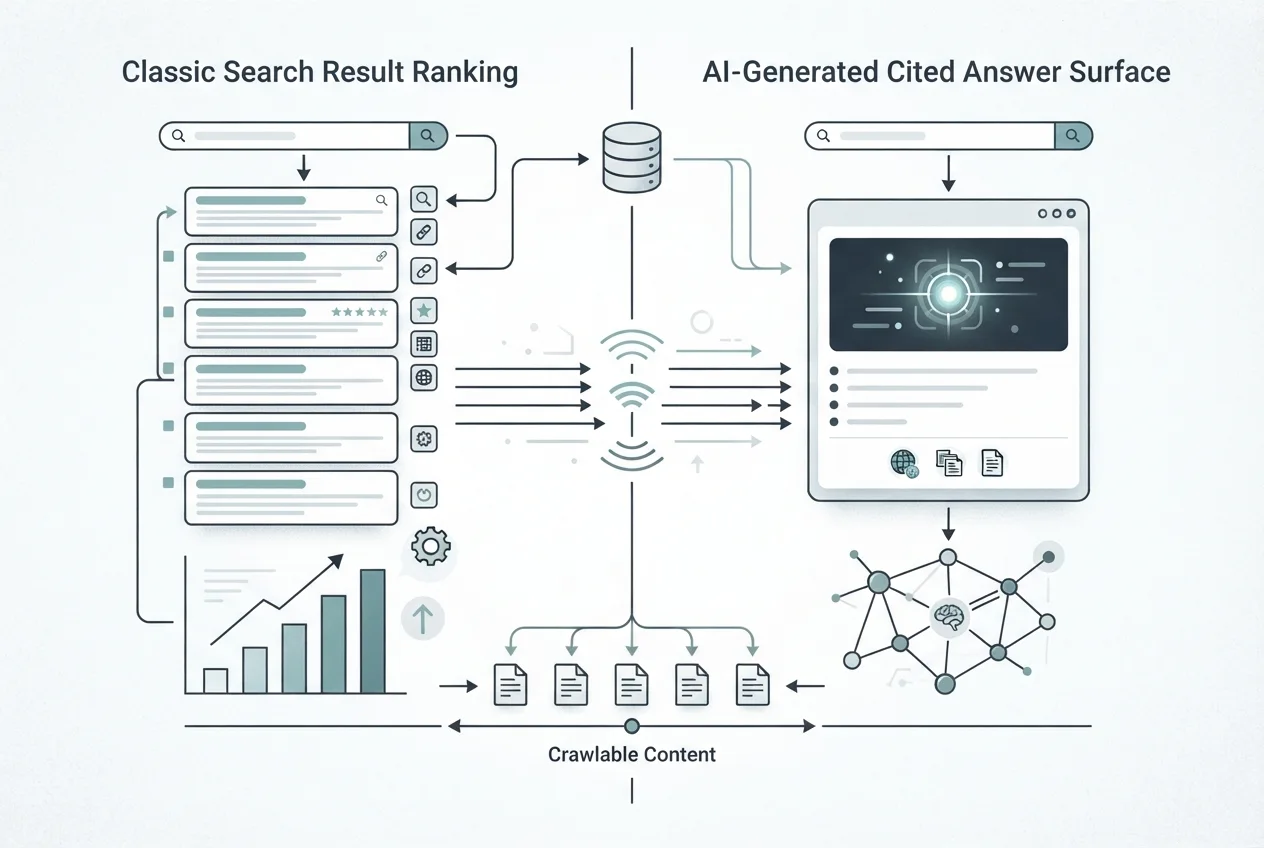
SEO earns visibility in search results. GEO earns visibility inside AI-generated answers. SEO optimizes pages for rankings, impressions, clicks, and traffic. Generative engine optimization (GEO) improves the evidence answer engines use to understand, cite, and recommend a brand. You need both because AI search still depends heavily on crawlable, useful web content, but the final output and the way you measure it are different.
GEO is also called answer-engine optimization (AEO) or LLM SEO. The terms overlap. In this guide, GEO means the work of improving brand presence in answers from ChatGPT, Claude, Gemini, Perplexity, Google AI Overviews, Microsoft Copilot, Grok, and Kimi. See what answer-engine optimization means for the broader definition, or use the focused AEO vs SEO comparison when that is the terminology your team uses.
GEO vs SEO at a glance
| Category | SEO | GEO |
|---|---|---|
| Primary goal | Rank a page for a query | Earn an accurate brand mention or citation in the generated answer |
| Main output | Search result, snippet, or landing page visit | Synthesized answer, recommendation, comparison, or cited source |
| Core metrics | Rankings, impressions, clicks, CTR, conversions | Presence, answer position, sentiment, citations, competitors, share of voice |
| Typical tactics | Technical SEO, keyword targeting, internal links, content, digital PR, backlinks | Direct answers, clear entities, original evidence, comparison content, third-party corroboration, prompt coverage |
| Primary tools | Search Console, analytics, crawlers, rank trackers, backlink tools | AI visibility checker, AEO tracker, answer archive, citation and competitor monitoring |
| Feedback loop | Publish, index, rank, earn clicks | Publish, run buyer prompts, inspect answers, fix evidence gaps, re-measure |
The practical difference is the unit you are trying to win. SEO tries to win a result. GEO tries to influence the answer built from many results and other sources.
What is generative engine optimization?
Generative engine optimization is the process of making a brand and its evidence easy for AI answer engines to retrieve, understand, verify, and use in a response. That includes your own pages, but it also includes documentation, reputable third-party coverage, customer language, reviews, comparison pages, and other public sources that corroborate a claim.
GEO is not a special file or a single schema type. Google’s current guidance says the same foundational SEO practices remain relevant for AI Overviews and AI Mode, and that there are no extra technical requirements for appearing in those features. Google also says a page must be indexed and eligible to show with a snippet before it can appear as a supporting link. Read the official Google guidance for AI features.
That makes technical SEO the entry requirement, not the whole GEO strategy. A page can be crawlable and still fail to appear in an answer because it does not provide the clearest evidence, because the claim is not corroborated elsewhere, or because the prompt maps to a different intent.
What SEO optimizes
SEO aligns a page with search demand and makes it eligible to rank. The work usually covers:
- Technical access: crawlability, indexing, canonical URLs, internal links, rendering, and page experience.
- Search intent: the job behind the query and the page format that best satisfies it.
- Topical coverage: useful, complete content with clear headings and supporting detail.
- Authority: links, mentions, reputation, and proof that make the page credible.
- Search presentation: titles, descriptions, structured data, snippets, and media.
The output is observable in search tools. Search Console can show impressions, clicks, click-through rate, and average position for a query or page. Those metrics tell you whether Google surfaced the page and whether someone clicked it.
What GEO optimizes
GEO starts with the same accessible, useful content and adds an answer-level layer:
- Prompt coverage: the category, comparison, alternative, problem, and implementation questions buyers ask an AI.
- Answer-ready passages: concise definitions, steps, criteria, tables, and facts that can be lifted without losing context.
- Entity clarity: consistent brand, product, category, audience, feature, and pricing language across public surfaces.
- Citable evidence: original research, transparent methodology, examples, documentation, and claims backed by primary sources.
- Corroboration: credible third-party pages that confirm what your own site says.
- Answer measurement: repeated checks showing whether the brand is named, how it is framed, and which competitors appear instead.
Google notes that AI features may use query fan-out, issuing related searches across subtopics and sources before composing a response. That is one reason narrow keyword matching is not enough. The page and its supporting evidence need to answer the surrounding questions too. The same Google AI features documentation explains this retrieval pattern.
Is GEO replacing SEO?
No. GEO does not replace SEO because answer engines still need discoverable source material. Google explicitly carries its Search quality and technical foundations into AI Overviews and AI Mode. Perplexity separately documents PerplexityBot for search discovery and Perplexity-User for user-requested page visits, which shows why crawler access and answer measurement need to be treated as different layers. See Perplexity’s crawler documentation.
What changes is the measurement boundary. A page can rank and receive impressions while the generated answer never names the brand. It can also be cited without becoming the recommended product. SEO data alone cannot show either outcome.
The useful model is:
- SEO makes the evidence discoverable and competitive.
- GEO makes the evidence easy to synthesize and corroborate.
- AI visibility tracking shows whether the answer actually changed.
Will SEO be replaced by AI?
AI changes how some searches are answered, but it does not remove the need for searchable, trustworthy source material. Search results, supporting links, publisher pages, product documentation, and original research remain part of the discovery chain. The more useful question is not whether SEO disappears. It is whether your reporting covers both the link and the answer.
Continue measuring rankings, traffic, and conversions. Add answer presence, citations, sentiment, competitors, and share of voice for prompts where an AI can shape the shortlist before a click happens.
How SEO and GEO metrics differ
SEO and GEO metrics should sit next to each other, not be forced into one score.
For SEO, track:
- Rankings and visibility by query cluster
- Impressions, clicks, and click-through rate
- Indexed pages and crawl issues
- Organic conversions and assisted revenue
- Referring domains and earned mentions
For GEO, track:
- Presence: whether the brand appears in the answer at all
- Answer position: whether it is the lead recommendation, one item in a list, or an alternative
- Sentiment and accuracy: how the engine describes the brand and whether the facts are current
- Citations: which sources support the response
- Competitors: which brands the engine recommends instead
- Share of voice: how often the brand appears across a fixed buyer-prompt set
- Movement: what changed between comparable runs
Use an AI visibility tool for the second list. A one-time AI visibility checker can establish the baseline, while AEO tracking software is for recurring prompt runs and movement over time.
A combined SEO and GEO workflow
The strongest workflow uses one content system and two feedback loops:
- Map real demand. Group Search Console queries, customer questions, sales objections, and buyer prompts by intent.
- Choose the canonical page. Give each intent one primary page so similar terms reinforce it instead of competing with it.
- Build the evidence. Add a direct answer, original examples, comparison criteria, primary sources, clear authorship, and a useful visual or table.
- Fix discovery. Confirm indexing, canonical URLs, crawler access, internal links, structured data, and server-rendered text.
- Distribute for corroboration. Earn relevant mentions through data outreach, expert contributions, partner content, and resources other publishers can cite.
- Measure both surfaces. Track search performance in Search Console and run the same buyer prompts across answer engines on a consistent cadence.
- Update the weakest layer. If the page does not rank, improve search intent and authority. If it ranks but the brand is absent from answers, improve evidence, entity clarity, and third-party corroboration.
For a page-level operating process, use the AI visibility optimization checklist. For tool selection, compare the best AI visibility tools.
Common GEO vs SEO mistakes
Creating separate pages for every synonym. GEO, AEO, LLM SEO, and AI search optimization often share intent. Split them only when the search result and buyer job are meaningfully different.
Treating crawler access as proof of visibility. An allowed crawler can fetch a page without the brand appearing in an answer. Test access and answer presence separately.
Publishing unsupported claims. Answer engines need evidence they can corroborate. Replace broad superlatives with methodology, examples, product facts, and reputable sources.
Checking one prompt once. Outputs vary by engine, wording, time, and sample. Save a representative prompt set and compare repeated runs.
Ignoring third-party sources. Your own site defines the product, but independent coverage helps confirm the claim. Digital PR and relevant backlinks support both SEO authority and GEO corroboration.
GEO vs SEO FAQ
What is the main difference between GEO and SEO?
SEO improves a page’s visibility in search results. GEO improves a brand’s visibility inside AI-generated answers. They share technical, content, and authority foundations, but target different outputs and require different measurement.
Is GEO the same as AEO?
The terms are commonly used for overlapping work. GEO emphasizes generative engines, while AEO emphasizes the answer surface. In practice, both focus on whether AI systems understand, cite, and recommend a brand.
Should a small team invest in GEO before SEO?
Usually no. First make the core site crawlable, indexable, useful, and aligned with buyer intent. Then measure the prompts where AI answers can influence a shortlist and add GEO work where the baseline shows a real gap.
What is the first GEO task to do?
Create a small set of category, comparison, alternative, and problem prompts. Run the same set across the answer engines your buyers use. Record brand presence, competitors, framing, and cited sources. That baseline tells you whether the first fix belongs on your site, in your distribution, or in your measurement process.