The GEO checklist: 12 ways to get cited by AI
Generative engine optimization is how you make a page the AI wants to quote. Twelve concrete, durable moves that earn citations.
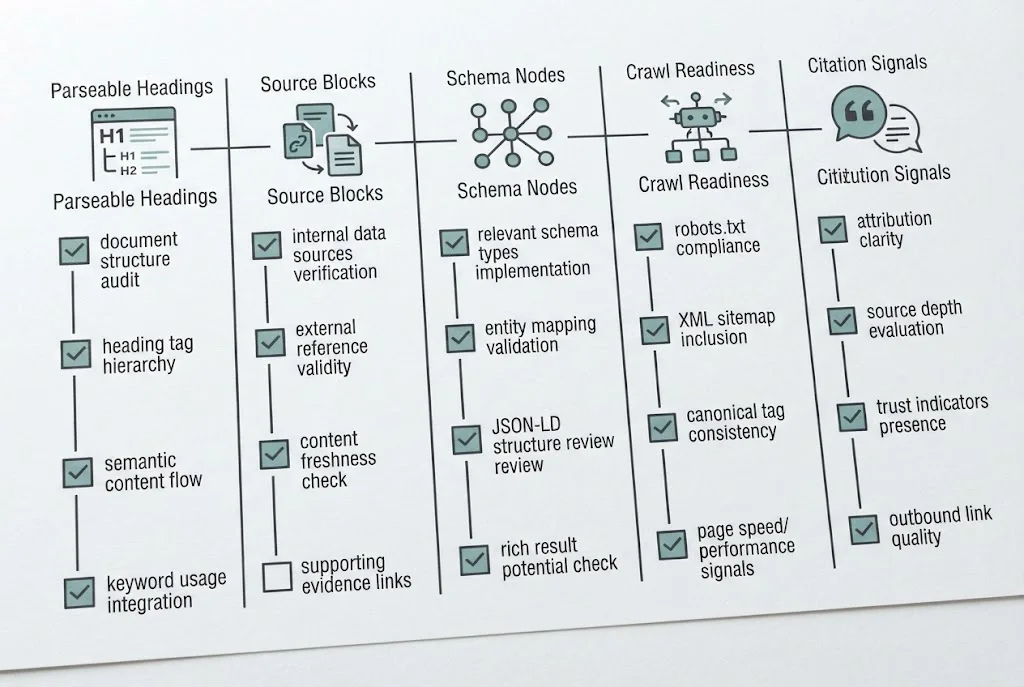
If AEO is the measurement, generative engine optimization (GEO) is the work. It is everything you do to make a page the kind of source an answer engine wants to quote.
Answer engines do not cite the loudest page. They cite the clearest, most trustworthy, most directly useful one. Here is a checklist of durable moves that earn citations, ordered roughly from foundation to finesse.
Be answerable
- Lead with the answer. Put the direct response in the first sentence under each heading. Engines lift self-contained statements, not slow build-ups.
- Write the questions as headings. Phrase your H2s the way a buyer phrases a prompt. “How much does X cost” beats “Pricing.”
- One claim, one paragraph. Tight, factual, quotable units travel better than sprawling prose.
Be trustworthy
- Cite your own sources. Numbers, dates, and references signal that you are a primary source worth quoting.
- Show authorship and recency. A named author and a visible “last updated” date both raise the odds of being cited for time-sensitive queries.
- Be consistent across the web. Your brand name, category, and key facts should read the same on your site, your profiles, and third-party mentions. Contradictions get you dropped.
Be parseable
- Use real structure. Headings, lists, and tables are how engines extract facts. A wall of text hides your best material.
- Add structured data. FAQ, Product, and Organization schema give engines a clean, machine-readable version of what the page says.
- Keep it crawlable. If the content only renders after a heavy client-side load, assume the engine never saw it. Server-render what matters.
Be the obvious choice
- Own comparison queries. “X vs Y” and “best X for Z” pages are where buyers decide. If you do not have an honest, useful version, a competitor’s will be cited instead.
- Cover the category, not just your product. Pages that genuinely explain the space get cited as references, which pulls your brand into adjacent answers.
- Close the loop with measurement. Publish, then watch whether the citation actually moves. GEO without AEO is guesswork.
The honest part
You will not win every answer, and you should not try. Pick the handful of prompts that map to real revenue, fix the pages that feed them, and re-measure. GEO is a loop, not a launch.
That last point is the whole game. Every item above is a hypothesis until you see the engine change its answer. Measure first, fix what is broken, and let the data tell you which of these twelve actually moved the needle for your brand.